
FIELD NOTE

AI Search Behaviour
NOTE #001

AI Users Are More Specific (And More Skeptical)

Early analysis suggests AI search users ask longer, more nuanced questions and show greater scepticism towards recommendations.

01

Observation

AI search users appear to ask longer, more detailed and more constrained questions than traditional search users.

We are also seeing more scepticism in the way people frame commercial queries. Users are increasingly requesting comparisons, trade-offs, evidence and potential downsides before accepting a recommendation.

The behaviour looks less like entering a search term and more like briefing an adviser.

More context. More constraints. More judgement.

02

Evidence

Query length across 50,000+ ecommerce-related prompts

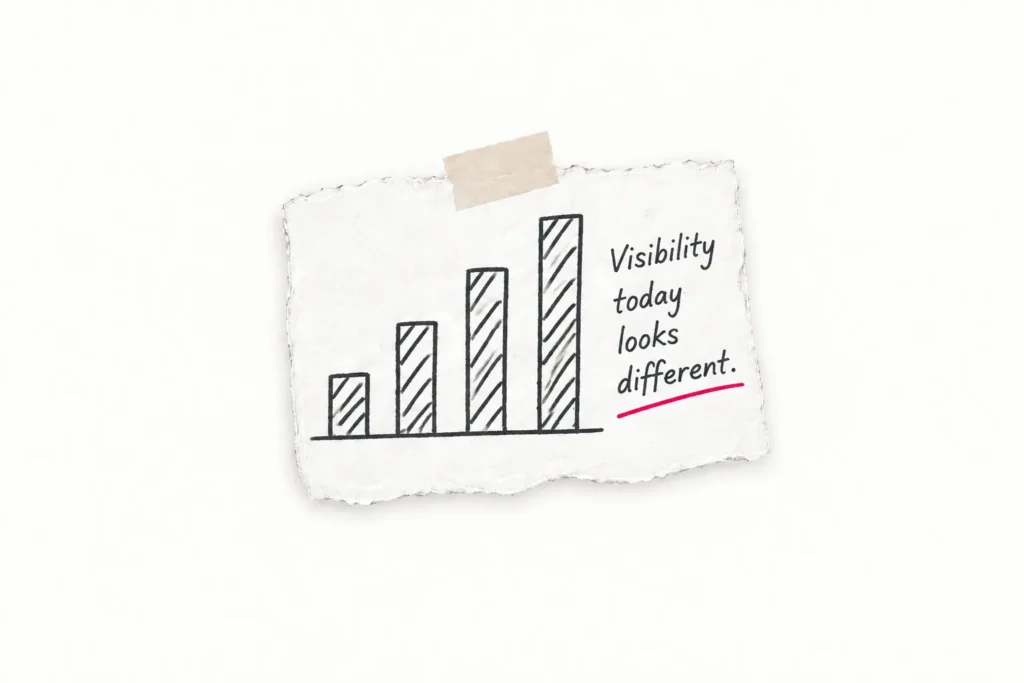
Across an early sample of more than 50,000 ecommerce-related queries, AI search prompts were approximately 2–3× longer than comparable traditional search queries.

The difference was not simply additional words. AI prompts contained more explicit requirements, contextual information and follow-up criteria.
blimpp_observation-hero
~2–3× longer in AI search. More context, more constraints.

03

Example queries from the sample

“I’m looking for a lightweight daily moisturiser for sensitive skin that works well under makeup and isn’t overly greasy.”

“What are the best noise-cancelling headphones for frequent travel in 2026? Include the main pros and cons, and how they compare with AirPods Max.”

“Is this running shoe actually worth the price? Are there better options for long-distance training under £150?”

Notice the comparisons, constraints and explicit scepticism.

04

Analysis

What we think is happening

More specific information needs Users provide richer context around their goals, constraints and preferences. This may reflect higher intent and a greater expectation of tailored advice.
Higher scepticism Users more frequently ask for sources, alternatives and potential downsides. Recommendations appear to be challenged more actively than in traditional search.
More complex tasks Queries increasingly involve comparisons, trade-offs and decision support rather than retrieval of a single fact.
AI search users seem to want depth, not just answers.

05

Implications

Implications / hypotheses

  • Product and content data may need to become more structured, comparative and sourceable.
  • Brands may benefit from surfacing genuine pros, cons and alternative options rather than presenting purely promotional claims.
  • Evidence-backed answers may become more persuasive as users increasingly challenge recommendations.
  • Comparison pages, FAQs, original research and citation-led content may become disproportionately valuable.
  • Content designed around a single short-tail keyword may miss the complexity of the underlying decision.
Test these. Don’t assume.

RESEARCH NOTE

Caveats

  • The sample currently covers a limited set of ecommerce categories, including beauty, home, technology and apparel.
  • This is not a representative sample of all AI search users.
  • Query classification is heuristic and may contain noise.
  • User behaviour may change rapidly as people become more familiar with AI search interfaces.
  • We still need to validate the behavioural interpretation using additional datasets and user interviews.

Next Steps

  • Analyse query length and structure by category.
  • Compare informational, commercial and purchase-intent prompts.
  • Measure the frequency of comparisons, constraints and sceptical language.
  • Run qualitative interviews with active AI-search users.
  • Test whether more evidence-led answer formats perform better.

Seen something interesting?

Want to share a signal?

Tell us what you’re seeing. We’re always looking for new examples, trends, and early signals to explore.