

By Harpal Singh, AI SEO consultant and founder of blimpp · Updated 26 August 2026
Most 8-figure beauty brands do not have an AI Search problem. They have a site architecture problem.
Their websites are still built around products, campaigns, collections, ingredients and brand storytelling. That worked when the main job was to rank in Google and convert the click.
But AI Search works differently.
Buyers are no longer only typing short keywords like:
- luxury face cream
- anti-ageing serum
- moisturiser for dry skin
They’re asking recommendation-led questions:
- What’s the best luxury moisturiser for dry mature skin?
- Best premium skincare routine for women over 40
- What should I use for dull skin and fine lines?
- Best retinol alternative for sensitive skin?
- Which luxury face cream is actually worth it?
Those aren’t product searches, they’re decision questions that fan out into sub-questions of each topic.
And most beauty eCommerce sites aren’t structured to answer them.
Instead, they’re structured around what the brand sells, not what the buyer is trying to decide.
What is Recommendation Architecture in Beauty AI SEO?
Recommendation Architecture is the process of structuring a website so AI engines can understand, trust, compare and recommend the brand.
Not just crawl it. Not just index it. Recommend it.
This is the practical on-site layer behind getting a health and beauty brand discovered in ChatGPT .
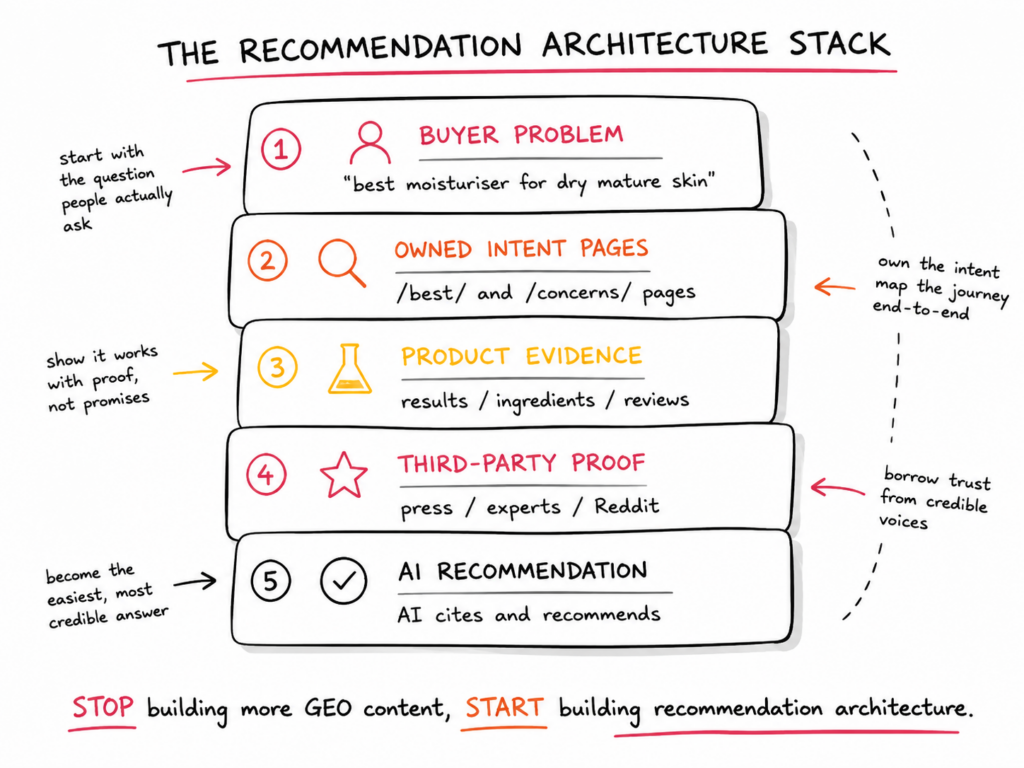
Recommendation Architecture starts with the buyer problem, then builds the evidence needed for AI engines to recommend the brand.
Why traditional beauty eCommerce structure is not enough
Most premium beauty sites follow a familiar structure:
/products/
/collections/
/ingredients/
/about/
/science/
/reviews/
There’s nothing wrong with that structure at all.
The problem is that it often starts too late in the buyer journey.
A product page is useful once the buyer already knows the product.
But non-branded AI prompts usually start with the problem:
Best moisturiser for dry mature skin
Not:
Should I buy this product?
That means AI engines need to work out several things before they can recommend the brand:
- What is the buyer’s problem?
- Which skin type or concern does it relate to?
- What product type is most relevant?
- Which ingredients matter?
- Which products fit the use case?
- What evidence supports the recommendation?
- How does the product compare to alternatives?
- Is there third-party proof?
If the site only gives AI engines product pages and brand copy, it makes the recommendation harder.
The brand might have the right product. But the site does not provide the recommendation pathway.
The core idea: AI Search starts with the problem, not the product
This is where most beauty brands get it wrong.
Traditional ecommerce starts here:
Product → Benefits → Buy nowAI Search often starts here:
Buyer problem → Options → Evidence → RecommendationSo the site structure needs to reflect that.
For a premium beauty brand, I’d build the on-site GEO structure in two layers.
Tier 1: Owned intent pages
Owned intent pages map the brand to non-branded buyer intent.
These are not generic blog posts. They are focused pages built around the exact recommendation questions buyers ask AI engines.
Example URL patterns:
/concerns/[concern]/best-products
/concerns/[concern]/routine
/best/best-[product-type]-for-[concern]
/best/best-skincare-for-[audience]
/routines/[concern]-routine
/routines/[audience]-skincare-routine
/compare/[ingredient]-vs-[ingredient]
/compare/[product-type]-vs-[product-type]
/guides/[buyer-question]
Example URLs:
/best/best-luxury-moisturiser-for-dry-skin
/concerns/dry-skin/best-products
/routines/skincare-routine-for-mature-skin
/compare/peptides-vs-retinol
/guides/which-product-should-i-start-with
These pages help AI engines understand where the brand fits.
They answer the buyer’s question before pushing the product.
Page type 1: /best/ pages
The /best/ page is designed for prompts where the user is explicitly asking for a recommendation.
Example prompt:
What is the best luxury moisturiser for dry skin?
Example URL:
/best/best-luxury-moisturiser-for-dry-skinThis page should not be a thin list of products. It should explain:
- who the product is best for
- what problem it solves
- why it fits the concern
- what evidence supports the recommendation
- how it compares to other product types
- which product is best for which buyer
A strong /best/ page gives AI engines a direct answer to a non-branded recommendation prompt.

A /best/ page starts with the buyer problem and explains why specific products are relevant.
Page type 2: /concerns/ pages
Concern pages are useful because beauty buyers rarely start with a product category. They start with a problem.
Example URLs:
/concerns/dry-skin/best-products
/concerns/barrier-repair/routine
/concerns/dull-skin/best-products
/concerns/fine-lines/ingredients
A strong concern page should cover:
- the buyer’s specific concern
- common symptoms or triggers
- relevant ingredients
- recommended product types
- product recommendations
- simple routine logic
- proof by concern
For example:
/concerns/dry-skin/best-productsThis page should help AI answer:
What should I use for dry skin?
But it should also support follow-up questions like:
- What causes dry skin?
- Which ingredients help?
- Do I need a serum or cream?
- What routine should I use?
- Which product is best if I only buy one?
That is how query fan-out works. AI engines do not answer one question in isolation. They break the decision into sub-questions.
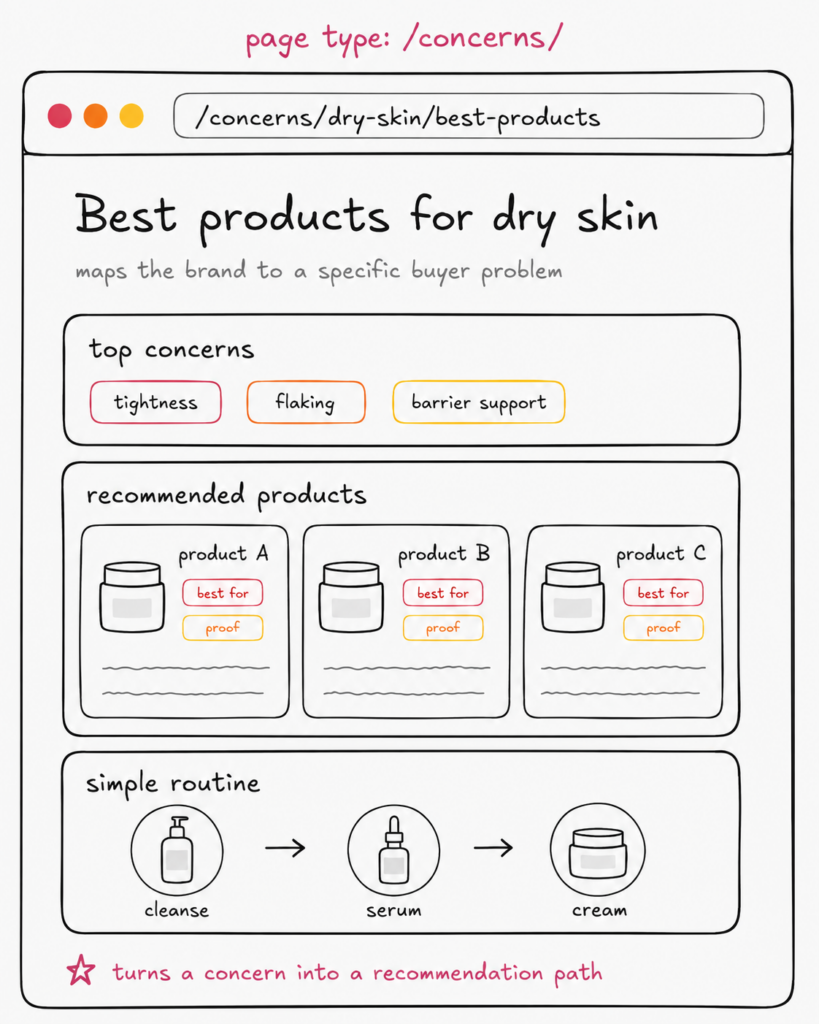
Concern pages turn a broad skin problem into a recommendation path.
Page type 3: /routines/ pages
Routine pages are highly useful for AI Search because many beauty prompts are not asking for a single product. They are asking for a complete solution.
Example URLs:
/routines/skincare-routine-for-mature-skin
/routines/barrier-repair-routine
/routines/glow-routine-for-dull-skin
/routines/evening-skincare-routine-under-5-minutes
A strong routine page should explain:
- who the routine is for
- when to use each product
- the correct order
- why each step matters
- what to avoid mixing
- how long results may take
- which products are essential versus optional
This helps AI engines recommend the brand as part of a complete routine, not just a single product.

Routine pages help AI engines understand order, fit and usage context.
Page type 4: /compare/ pages
Comparison pages are critical for GEO because AI Search often behaves like a decision engine.
Buyers ask:
- Peptides vs retinol
- Serum vs moisturiser
- Luxury moisturiser vs clinical moisturiser
- Which face cream is worth it?
- What is the best retinol alternative for sensitive skin?
Example URLs:
/compare/peptides-vs-retinol
/compare/serum-vs-moisturiser
/compare/luxury-moisturiser-vs-clinical-moisturiser
/compare/retinol-vs-retinol-alternatives
A good comparison page should make the decision easier. It should cover:
- best for
- benefits
- watch-outs
- skin type suitability
- evidence
- when to choose each option
- which product fits each use case
Comparison pages reduce recommendation friction. They make it easier for AI engines to justify why one product, ingredient or routine is the better fit.

Comparison pages help AI engines answer decision prompts clearly.
Page type 5: /guides/ pages
Guide pages should answer high-intent buyer questions directly.
Example URLs:
/guides/which-product-should-i-start-with
/guides/is-premium-skincare-worth-it
/guides/how-to-layer-skincare
/guides/how-long-skincare-results-take
/guides/what-to-use-after-retinol
These are not generic educational blog posts. They should answer the specific questions that appear during the buying journey.
For example:
/guides/which-product-should-i-start-withThis page helps AI answer:
Which product should I buy first from a premium skincare brand?
A strong guide page should include:
- buyer concern
- skin type
- recommended starting point
- why that product fits
- how to use it
- what result to expect
- when to upgrade to a fuller routine
These pages are useful because they are easy for AI engines to quote. They are focused, direct and decision-led.

Buyer-question pages give AI engines clear, quotable answers.
Tier 2: Product evidence pages
Owned intent pages help AI engines understand fit. Product evidence pages help AI engines justify the recommendation.
Example URL patterns:
/products/[product]
/products/[product]/who-its-for
/products/[product]/results
/products/[product]/ingredients
/products/[product]/reviews
/products/[product]/faqs
These pages should not just repeat product benefits. They should provide structured evidence.
For each product, AI engines should be able to understand:
- who it is for
- who it is not for
- which skin types it suits
- which concerns it targets
- what ingredients matter
- what results customers report
- what clinical or expert proof exists
- where it fits in a routine
- what it pairs with
- how long it takes to see results
This matters because AI engines do not only need a product name. They need a reason to recommend it.
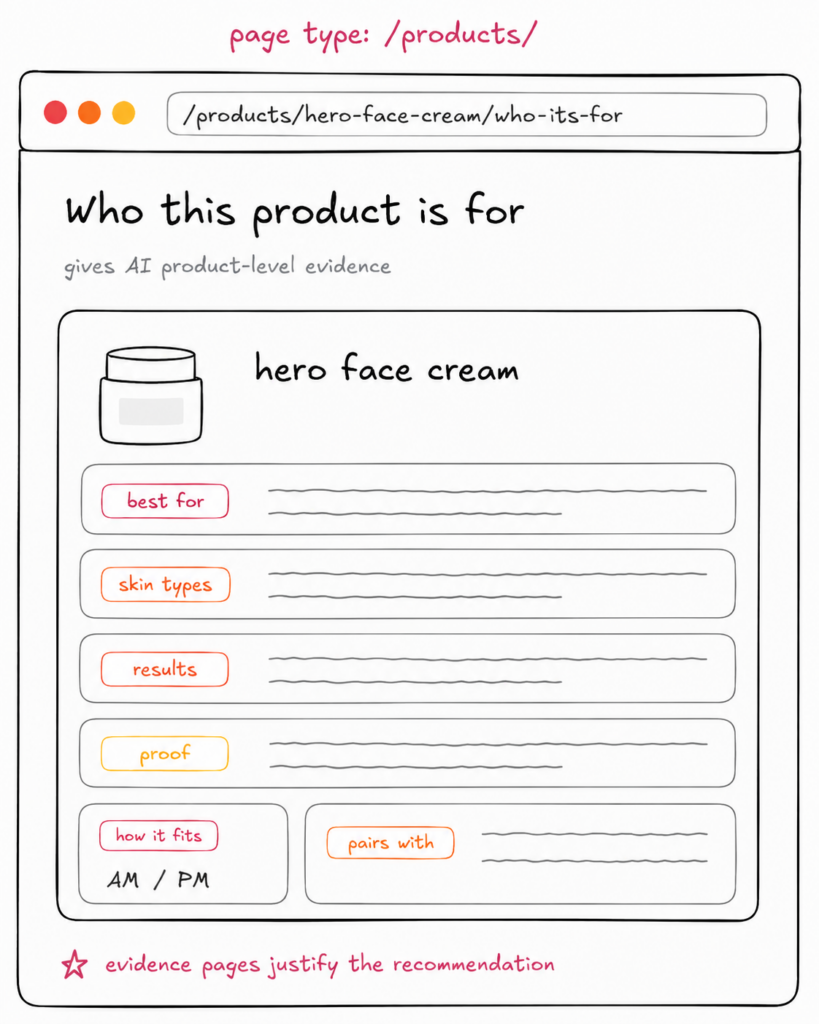
Product evidence pages justify the recommendation with fit, proof, ingredients, results and reviews.
Why this structure matters for query fan-out
AI engines don’t always retrieve one page for one prompt.
A prompt like:
Best premium skincare routine for women over 40
Can fan out into multiple underlying questions:
- What skin concerns matter after 40?
- Which ingredients are most relevant?
- What should the routine order be?
- Which products fit each step?
- What proof exists?
- Is the routine worth the price?
- What do real customers say?
If the site has only product pages, it can’t answer the full decision journey.
But if the site has owned intent pages, comparison pages, routine pages, guide pages and product evidence pages, the brand becomes much easier to understand and recommend.
And that’s the point of Recommendation Architecture.
It gives AI engines the building blocks they need.
This is why AI SEO work should start by finding the sources, questions and pages AI engines already rely on. That is the same principle behind reverse-engineering ChatGPT’s clean beauty recommendations .
Third-party proof still matters
There is one important caveat.
A brand’s own website is not enough.
For truly non-branded prompts, AI engines often look beyond the brand’s site. They may use:
- reviews
- press
- stockists
- expert commentary
- creator content
- Reddit threads
- forum discussions
- awards
- clinical references
That means the strongest GEO strategy combines:
Owned intent pages
+ product evidence pages
+ third-party validation
The owned site helps AI understand the brand.
Third-party proof helps AI trust it.
This is especially important for prompts like:
Which luxury face cream is actually worth it?
That kind of prompt requires more than a brand claim. It needs evidence from customers, reviewers, publishers and communities.
The practical audit
For an 8-figure beauty brand, I would start with the top 25–50 non-branded AI Search prompts across:
- concerns
- routines
- ingredients
- comparisons
- price objections
- product selection
- skin type
- age-related use cases
Then map each prompt to the current site.
Ask:
- Do we have a page that directly answers this?
- Is the page focused enough to be cited?
- Does it explain who the product is for?
- Does it compare alternatives clearly?
- Does it provide evidence?
- Does it connect to a relevant product page?
- Is there third-party proof supporting the claim?
Most brands will find the same gap.
They have the products. They have the claims. They have the reviews. But they do not have the structure.
This is the type of audit an AI SEO / GEO consultant should be running before recommending more content.
Final thought
Beauty GEO is not about publishing more content.
It’s about making the brand easier to recommend.
That means building pages around the buyer’s problem, then supporting those pages with product evidence and third-party proof.
Most beauty sites start with the product.
AI Search starts with the problem.
The brands that understand that shift will have a real advantage.
The goal is simple – make your brand the easiest credible recommendation for AI engines.
That is Recommendation Architecture.
Related reading
- How to Get Your Health & Beauty Brand Discovered in ChatGPT
- I Reverse-Engineered ChatGPT’s Clean Beauty Recommendation
- Reddit Is Now Writing Your Brand’s AI SEO Reputation
- Harpal Singh – AI SEO / GEO Consultant
Want to know what AI engines recommend in your category?
blimpp builds products that show brands how AI search engines recommend their category, which competitors are winning the answer, and which sources are shaping the recommendation.
