
By Harpal Singh, AI SEO consultant and founder of blimpp · Updated 26 August 2026
Every marketer has been told the same thing about AI search:
“rank well on Google and the AI engines will find you”.
It’s wrong.
Ask ChatGPT for the best anything and watch where its answer comes from. It’s not reading your Google rank, it’s reading a different index entirely, and your position in that index is something most brands have never once checked.
The conventional story is clean and it sounds right. AI search is just search with a chat wrapper. Google is the dominant search engine. So win Google, get your rankings up, earn your backlinks, and the AI answer engines, being downstream of the same web, will surface you too.
It’s a comforting story because it means you don’t have to learn anything new. Your existing SEO investment covers it, just keep doing what you were doing and things will turn out fine.
Google’s own AI Overviews run off Google’s index, so for that one engine, your Google work carries over OK. So teams extrapolate, and assume the biggest AI engine, ChatGPT, works the same way. They pour effort into Google position and treat AI visibility as a free side effect of good SEO.
And that’s just the problem.
For its web answers, ChatGPT reads Bing, not Google. That one fact reorganises everything you thought you knew about ranking.
Finding 1: ChatGPT Search Retrieves Through Bing’s Index
Due to the Microsoft-OpenAI partnership every URL ChatGPT considers for a web-grounded answer is discovered through Bing’s search infrastructure first, NOT Google’s. If Bing hasn’t indexed your page, ChatGPT can’t find it, no matter how well you rank on Google. So your Google rank has zero direct influence on whether ChatGPT can cite you.
Finding 2: The Overlap Isn’t Close
Seer Interactive analysed 500+ ChatGPT citations and found roughly 87% matched Bing’s top results. Your Bing position, not your Google position, is what predicts ChatGPT visibility. If you thought that was the case, you’ve been measuring the wrong index.
Finding 3: Copilot Rides The Same Rail
Microsoft Copilot shares ChatGPT’s search backbone, and so do a cluster of smaller search engines. Optimise for Bing and you cover a cluster of engines at once. Treat Bing as the shared front door to a whole group of AI answers, not as one small engine you can skip.
Finding 4: The Two Indexes Weight Pages Differently
Bing leans harder on exact-match keywords and on-page freshness relative to backlinks than Google does, so a well-structured, recently updated page with moderate authority can rank in Bing where it would struggle in Google’s more backlink-dependent model. So a page that underperforms on Google can still win citations, so long as it’s in Bing and tuned the way Bing rewards.
Two Indexes, Two Pipes
Google’s index feeds Google Search and Google’s AI Overviews. Bing’s index feeds ChatGPT, Copilot, and the smaller engines that discover through Bing. Think of these are separate pipes. Being excellent in one tells you nothing about your position in the other.
Most brands have a Google Search Console account they check weekly or monthly and a Bing Webmaster Tools account they’ve never opened. So they have rich data on the index that feeds one AI engine and zero data on the index that feeds the biggest one.

What Happens When A Buyer Asks ChatGPT For The Best CRM
Walk a real query through it. Someone asks ChatGPT for the best CRM for a small agency. ChatGPT sends that query to Bing, pulls the top web results Bing returns, and synthesises an answer from those pages. If your CRM’s comparison page ranks page one on Google but isn’t in Bing’s index, it’s not in the candidate set, and can’t be named.
And this matters more than a passing mention, because of where the recommendation lands. By the time ChatGPT names a product, the buyer is usually three or four questions deep into a conversation they trust, so they act on the name they’re given rather than opening ten tabs to compare. Being the named page is the recommendation the buyer runs with, which is why it’s worth engineering for rather than treating as a vanity metric.
The Quick Check
You can watch this happen with one quick check.
Run site:yourdomain.com on Bing, not Google.
Count what comes back. Then run the same on Google. If Bing returns a fraction of what Google does, that gap is the exact set of pages ChatGPT can’t currently cite, no matter how well they rank for you elsewhere. Most brands have never run this comparison, and the first time they do, the gap is bigger than they expect.
So here’s what to do about it.
Step 1: Register In Bing Webmaster Tools And Import From Google Search Console
Start by registering your domain in Bing Webmaster Tools this week.
The fastest route is the import. Bing Webmaster Tools lets you pull your verified site and settings straight from Google Search Console, so you’re set up in minutes instead of re-verifying ownership from scratch. Sign in with the Google account tied to your GSC, choose import, and your site and sitemap come across.
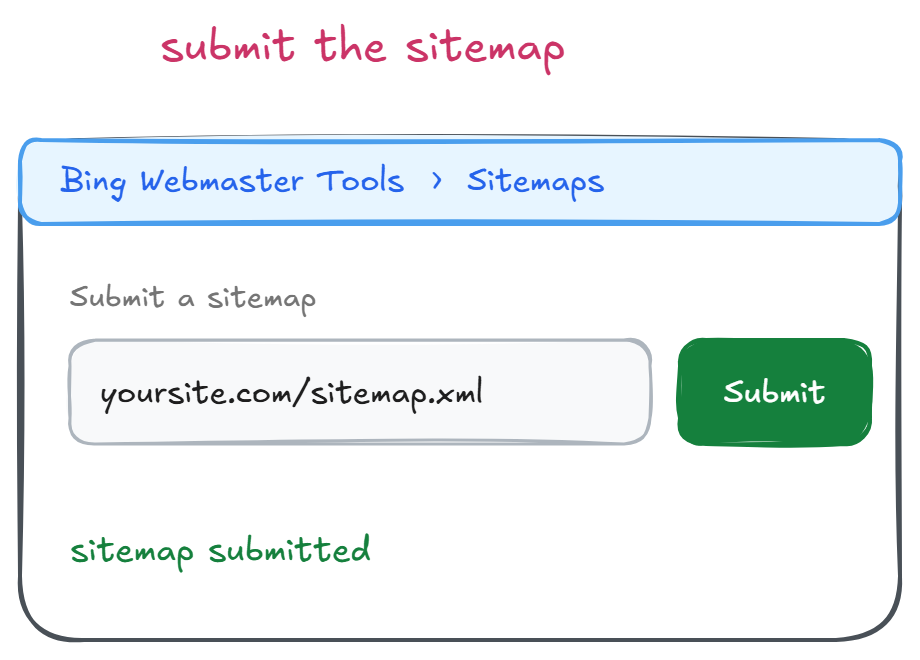
Then do three things. Submit your sitemap if the import didn’t carry it. Use the URL inspection tool to request indexing on your priority pages, the about page, your best comparison pages, so you’re not waiting on Bing to find them at its own pace. And read what Bing flags, because Bing brings up indexing and crawl issues that Google Search Console never mentions, and if so, remember that those are pages ChatGPT currently can’t see. This is the single most valuable hour you’ll have in your working day, because it moves you from invisible to visible on the index that feeds ChatGPT.
Step 2: Push New URLs To Bing Instantly With IndexNow
Stop publishing and waiting weeks for a crawler to notice. Start using IndexNow so new and updated URLs push to Bing instantly.
IndexNow is a free, open protocol that notifies participating engines the moment you add, update, or delete a page, instead of waiting for a crawler to stumble on the change on its own schedule. The workflow is three parts.
Generate a key. It’s only a random hexadecimal string, eight to 128 characters; host that key as a UTF-8 text file at your domain root, at yourdomain.com/yourkey.txt, so the engine can hit that URL and confirm you own the domain.
Then, on publish, POST the changed URL to the IndexNow endpoint with your key and key location attached. Submit to Bing’s endpoint or the shared global one and the submission propagates across every IndexNow-enabled engine at once.

You almost certainly don’t have to hand-code this, because most CMS platforms have a plugin that generates the key, hosts the file, and fires the submission automatically on every publish, update, and delete. If you’re on a custom stack, a small build hook or a few lines against the API does the same job.
Google doesn’t support IndexNow. It still relies on its own crawling and sitemaps. So IndexNow is a Bing-and-downstream tool, which, given that Bing feeds ChatGPT and Copilot, is exactly the thing that matters for AI Search citations. It cuts your update lag on that index from weeks to hours, so a page you publish today can be discoverable to ChatGPT far sooner than if you waited for a crawl.
Step 3: Make Bing Webmaster Tools A First-Class Dashboard
Stop reporting AI-search health from Google Search Console alone, and start watching Bing Webmaster Tools as a first-class dashboard.
Use its URL inspection to request indexing for priority pages, and its site explorer to confirm your publishing velocity matches your indexing rate. When a page improves its Bing position, expect a lag, typically a few weeks, before it enters ChatGPT’s citation rotation. ChatGPT doesn’t cite fresh Bing pages in real time. Knowing that lag exists stops you panicking on day three and stops you giving up on day ten.

