
By Harpal Singh, AI SEO consultant and founder of blimpp · Updated 26 August 2026
Here’s the mistake almost every content team makes when they finally decide to chase AI citations.
They write a great page on the topic, give it a nice headline, and wait. But ChatGPT bot walks straight past it, because the page answers a subject, not a question.
Instead, turn a page from “about the topic” into “the answer to the question”. It’s a single tactic, and if you do the whole thing rather than half of it, the page can become cited for its question inside a few weeks.
Here’s how to build it.
What The Query Fan-Out Is
Before you write a word, understand what the AI engines are actually doing when someone types a question, because the whole tactic is shaped around it.
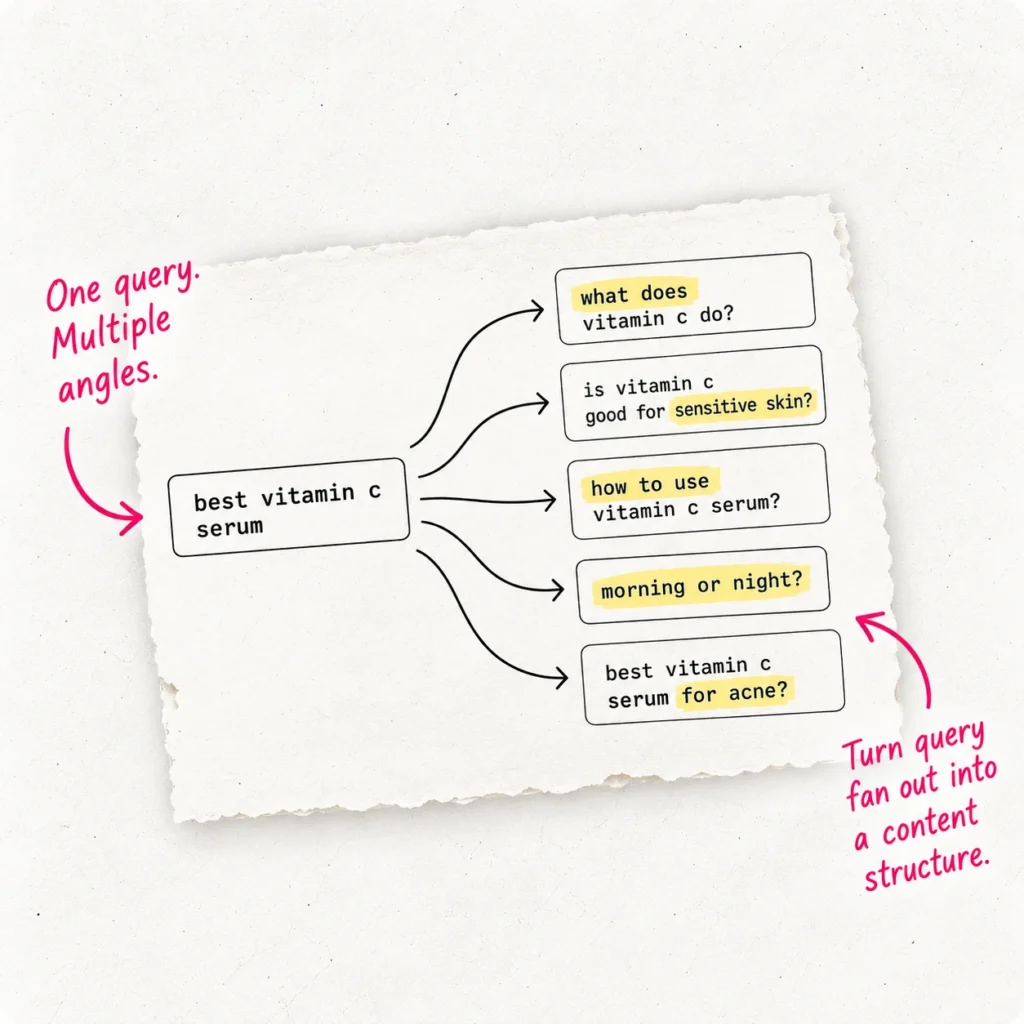
The engine takes the query and fans it out into sub-questions. Ask it “what’s the best CRM for a small agency” and under the hood it’s also asking:
- “which CRMs are built for small teams”
- “what do agencies need from a CRM”
- “how much do they cost”
- “which are easiest to set up”
This is called the query fan-out. It then goes looking for pages that resolve those sub-questions, and it matches those by semantic similarity, or how closely the page’s content maps to the actual buyer question and its parts.
So the page that wins isn’t the broadest or the most beautifully written, but the one that most completely addresses the specific question and the sub-questions hiding inside it. A narrow page built and titled around the exact question beats a 5,000 word page with a clever headline, every time, because the clever headline is a worse semantic match, and the sprawl dilutes the signal.
So here’s how to build citation-worthy question-answer pages.
Step 1: Pick One Real Question & Check You Don’t Already Target It
Start from a real buyer question, the actual phrasing a person would type or say. I pick mine from a fixed list of fifty buyer questions I locked at the start of the campaign, but you can source yours from the questions customers ask in sales calls, in support tickets, in the search box.
One question, one page.
Then run site:yourdomain.com plus the question in Google to check you don’t already have a page half-targeting it. If you do, you’re better off fixing that one than splitting the signal across two.

Step 2: Set The Title Tag & H1 To The Question
This is the step people flinch at, because it feels less clever than a fancy headline. Do it anyway. Your title tag and your H1 should be the buyer question, more or less word for word, not a witty reframe of it.
“What’s the best CRM for a small agency?” not “CRM Showdown: Our Definitive Verdict”.
The word-for-word question is the strongest possible semantic signal that this page addresses that actual query.

Step 3: Answer In The First 100 words, Then Fan Out
Put a ‘capsule’ answer in the opening 100 words. This is a direct, extractable, two-to-three-sentence answer to the question, before any preamble or scene-setting. And this is what the engine lifts.
Then, fan the body out into the sub-questions as H2s, the same sub-questions the AI engine usually decomposes the query into, and answer each one directly.
Bonus if you add one real example with actual numbers, because specifics are more citable and more credible to the LLM. Extra bonus if you close with a short FAQ covering the questions people usually ask next. In other words, you’re aiming to resolve the whole question cluster, after initially addressing the top-level question.
Let’s make it concrete. Say the question is “what’s the best CRM for a small agency”, your capsule answer names a direct recommendation in the first two sentences. Then your H2s are the sub-questions: “what do small agencies actually need from a CRM”, “how much should a small agency pay”, “which CRMs are easiest to set up with no admin”, “what do you lose going cheaper” etc. Each H2 gets a plain, complete answer. Go further with a real-life example with figures (i.e. a five-person agency, this many contacts, this monthly price, this setup time etc.) and your FAQ mops up the next questions: “can I migrate from a spreadsheet”, “does it integrate with my invoicing” etc.
By the end, the page has resolved every branch the engine split the query into, which is exactly what makes it a strong question-answer article. A rival page that only answers the headline question and ignores the sub-questions (the fan-out) is a thinner semantic match, and it loses.

Step 4: Run It Through An Editing Pass For Links & Schema
Before publishing, do a structured edit. Add internal links to your related pages and a few authoritative external ones, because links give the engine context about how this page sits in a wider body of work and where its claims are grounded.
Add the relevant schema, FAQPage schema for the FAQ, Article schema for the page, so the machine gets the structure spelled out instead of having to infer it. Write a meta description that restates the question and the capsule answer, because that’s often what shows in the result and it reinforces the semantic match.

Step 5: Publish, Then Request A Recrawl
Don’t wait for the crawlers to find it on their own schedule. Publish, then request indexing in Google Search Console and submit the URL in Bing Webmaster Tools (even better, set up IndexNow to automatically sync this). This is the difference between the page being discovered in days versus weeks, and given that Bing feeds ChatGPT, the Bing submission is the one that matters most for AI citations.
Here’s what to expect if you do the whole thing. The page tends to enter citation for its question within one to three weeks, and in my experience the fastest movers are Perplexity and Google AI Overviews, because they lean hardest on live retrieval and semantic matching. ChatGPT usually follows once the page settles into Bing’s index. You haven’t guaranteed a citation, but you’ve built a page that fully resolves one exact question, in a highly citable way.
One page, one question, fully answered, titled as the question, crawled on purpose. Do that fifty times and you’ve built a site the engines can’t help but quote.
Why The Plain Question Isn’t A Downgrade
A last word on the part that trips people up, because it’s a real fight with most clients once they reach a certain stage of maturity. Using the buyer question as your title feels like giving up your voice. Brands spend years training themselves to write clever, punchy headlines, and here I’m telling you to write the plain question instead.
It feels like a downgrade, but it isn’t. The clever headline was optimising for a human deciding whether to click in a list of ten blue links, and that world is shrinking. The plain question optimises for the machine deciding whether you’re in the answer at all, a world that’s growing.
You’re not abandoning good writing, the capsule answer and the body still need to be good, you’re moving the cleverness off the title, where it now costs you to be anything other than relevant, and into the substance, where it still pays.

