

By Harpal Singh, AI SEO consultant and founder of blimpp · Updated 26 August 2026
Ask ChatGPT: “who is Duolingo and who founded it?”
It answers instantly. A language-learning company, founded 2011 by Luis von Ahn and Severin Hacker, based in Pittsburgh, the app with the owl. It doesn’t say “let me check”, it states Duolingo (the entity) like a known fact.
Now ask it the same shape of question about a lesser-known person or brand. It stitches a description out of whatever fragments it can find, and sometimes it’s wrong.

The difference between those two answers isn’t luck, but a thing you can actually build: the entity home.
We’re going to take one clean “who is X” answer apart, piece by piece, and show why the machine says what it says, so you can author the same thing for your own brand.
Every “Who Is X” Answer Is Five Slots
When an engine answers “who is X” for a well-known brand, more often than not it comes back with a fat stack of facts; what the thing is (category), who made it (named founders), when (founding year), where (location), and what it’s known for (a one-line claim to fame).
Each of those facts is a slot, and all the AI engine is doing is filling slots from a description it trusts. Category slot: filled. Founder slot: filled with two specific names. Year slot: filled. Location slot: filled. Every slot has a confident value, and the confidence comes from the same value appearing, consistently, in the sources the engine reads.
For a brand it doesn’t know well, the same slots come back empty or even worse, contradictory.
The Quick Check: Ask Three AI Engines “Who Is [Your Brand]”
You can see your own starting point in a minute. Ask two or three engines “who is [your brand]” and “who founded [your brand]”, and write down which slots come back filled, which come back vague, and which come back wrong. That list of empty and wrong slots is your work for the week, and the rest of this is how you fill them.
The Four Sources ChatGPT & AI Engines Cross-Reference
Read a well-known entity answer on ChatGPT and you can see the top web results it’s drawing from.
The first and most important source is the brand describing itself, in plain language, on one authoritative page (i.e. one with plenty of internal links). This is the page that answers “who and what is this” in its opening sentences, names the founders, states the year, and location. The engine trusts this because it’s the primary source, and because a well-built about page states the facts in extractable sentences rather than burying them in a boring brand story.
Underneath the words sits the machine-readable version: Organization schema and Person schema in JSON-LD. This isn’t visible to a human reader, but it hands the engine the same facts in a format it can’t misread: legal name, founding date, location, founder, and sameAs links out to the brand’s other profiles. This is the difference between the engine inferring your category from context and being told it outright. Schema turns “probably a software company” into “Organization, category stated, founder stated.”
One Source Is A Claim, Five Sources Are A Fact
Then the other stuff, like LinkedIn, Crunchbase, Wikidata, and industry directories. The engine cross-references what the brand says about itself against what these say. When they agree, it becomes more confident. Google’s Knowledge Graph alone holds on the order of 800 billion facts about roughly 8 billion entities, and AI engines lean on that graph when deciding whether a brand is a known thing or not. Agreement across sources is the whole point here. One source saying you exist is a claim, but five sources saying the same thing is a fact.
Finally, the press and article mentions that repeat the same facts in the wild: the founder’s name attached to the company, the company attached to its category. These aren’t under the brand’s control, which is exactly why the engine particularly relies on these (they confirm what your on-site schema claims).
Look across all four source types and they should agree on the facts. The about page states the founding year, the schema encodes the same year, Crunchbase lists the same year, press repeats it. All ChatGPT or Google AI Overviews are doing here is observing a consensus, and it reports consensus with confidence.
This is why a single strong about page or founder bio isn’t enough, and why a scattered set of contradictory mentions actively works against you. Author the source, and make sure that the rest lines up behind it. Leave it unwritten, and the engine stitches an identity from fragments, which is how brands end up misdescribed in AI answers.
Step 1: Rewrite Your About Page As The Entity Home
Write or rewrite your about page as the entity home. Paragraph one answers “who and what is this brand” in plain nouns: category, what it does, founding year, the legal entity behind it, location. Paragraph two answers “who is the founder” with the name and a one-line descriptor. State facts in extractable sentences, not buried in a wordy brand narrative.

Step 2: Add Organization And Person Schema
Add Organization and Person schema to that page in JSON-LD, with stable @ids and a sameAs array pointing to every profile you control. The Organization block carries brand name, url, logo, description, foundingDate, location, and the sameAs array; the Person block carries the founder’s name, a role descriptor, and their own sameAs links out to their professional profiles. Give each a stable @id so you can reference the person from the organisation and bind the two together.
Step 3: Make It The Most Internally Linked Page On Your Site
Make that page the most internally linked page on your site, from your global footer and your author pages, so both crawlers and readers treat it as canonical. Perhaps boring to do, but it tells the engine which page is the source of truth.
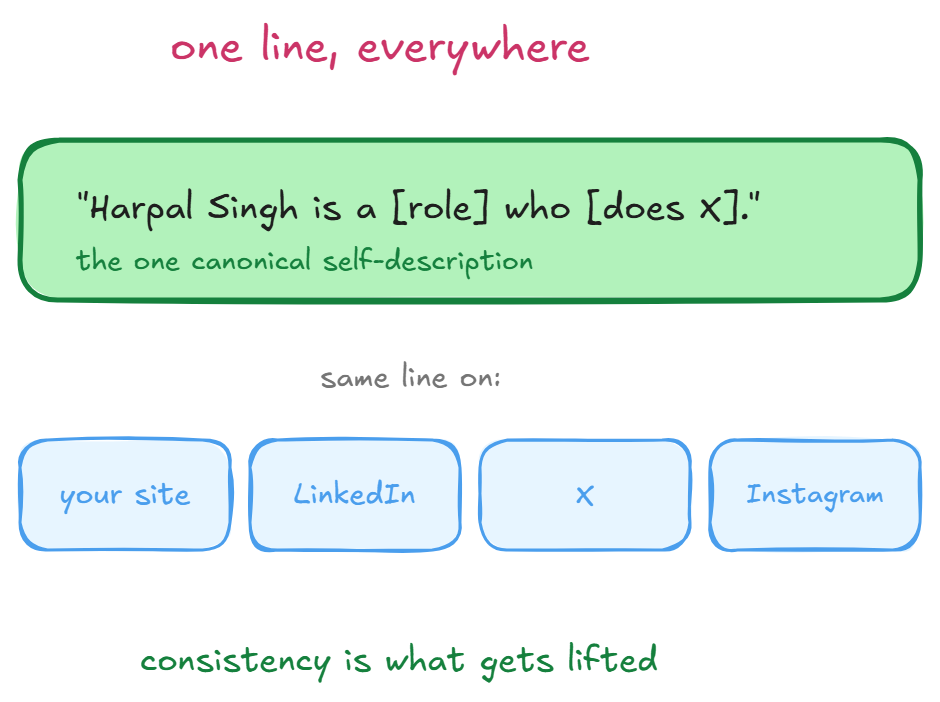
Then align everything else. Confirm LinkedIn, Crunchbase, and any directory listings state the same facts, so all cross-referencing sources agrees on the same thing.

